
Web Development
Which Type of Website Is Recommended for Your Business
Choosing the right website for a business is one of those decisions that feels simple until the options start stacking up. A site can be a basic online brochure or a completely developed digital store with memberships, bookings, and custom tools. The best choice depends on what the business actually needs right now, how much time and money are available, and where it wants to go in the next year or two.
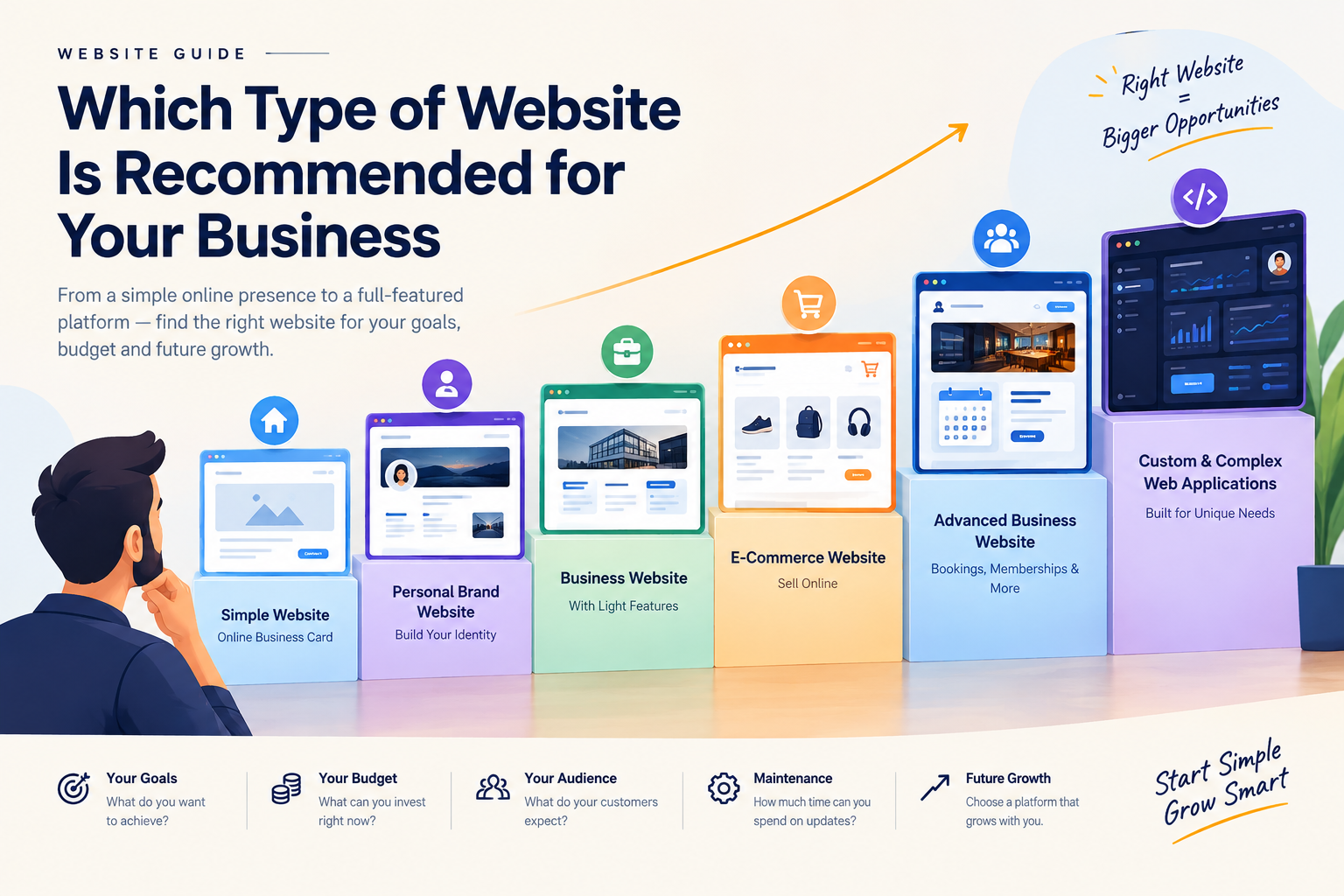
Most businesses start somewhere in the middle of the spectrum and grow from there. Going too simple can limit growth. Going too complex too early can waste money and create headaches. Here is a clear look at the main types of websites, moving from the simplest to the most advanced, so the decision becomes easier.
Simple Websites That Works as The Online Business Card
The simplest websites are static or one-page sites. These work like a digital business card or brochure. They usually have a few pages: Home, About, Services or Products, and Contact. The design stays fixed. Content does not change often. There is no shopping cart, no login area, and no complex forms beyond a basic contact form.
These sites load quickly and cost less to build and maintain. Many small local businesses use them successfully. For example, plumbers, consultants, photographers, or independent tutors. A visitor can quickly see what the business offers, read a short introduction, and get in touch by phone, email, or a simple form.
The main strength is clarity. There is no mess. Visitors find what they need fast. The downside is limited growth. If the business later wants to sell products online, publish regular updates, or collect customer information in more advanced ways, the site will need a major upgrade or complete rebuild.
A one-page website is an even simpler version. Everything sits on a single scrolling page with sections for different topics. It works well for freelancers, event promotions, or very small service providers who mainly want an online presence and a way for people to reach them.
Personal Brand Websites
Personal brand websites focus on an individual rather than a company. They are built around a person’s name, story, expertise, and professional identity. These sites typically include a strong About section, a portfolio or selected work samples, a blog or insights page, media mentions, speaking topics, and clear ways to connect or hire the person.
Coaches, consultants, speakers, freelancers, authors, and industry experts often use this type of site. The goal is to build trust and recognition around the individual so visitors see them as the go-to person in their field. Content tends to be more personal and story-driven than on a standard business site, yet the structure remains relatively straightforward.
These websites sit between simple brochure sites and fuller business sites. They usually stay easy to update and do not require complex tools at the start. Over time many grow by adding a newsletter signup, online booking, digital products, or a membership area. The focus stays on the person first, with business features added only when they support that personal brand.
Basic Business Websites with Light Features
This includes multi-page sites that still stay relatively straightforward but add a few useful tools. These often include a blog or news section, photo galleries, downloadable PDFs, and slightly more advanced contact or quote forms. Some also have basic appointment booking or newsletter signup options.
Many professional service businesses fall into this category, like accountants, lawyers, real estate agents, and design studios. The site still focuses on information and trust-building, but it gives a bit more room to show expertise through articles or case studies. Search engines tend to favor sites that publish fresh content, so a simple blog can help with visibility over time.
These sites are usually built on content management systems that make updates easier for non-technical people. The cost sits higher than a pure static site but remains manageable for most small to medium businesses. Maintenance stays reasonable as long as the design and features stay limited.
E-Commerce Websites for Selling Online
When a business wants to sell products or services directly through the website, e-commerce becomes the natural choice. These sites include product listings, shopping carts, secure payment systems, inventory tracking, and order management.
There is a wide range within e-commerce itself. A small online store with a handful of products can stay relatively simple. Larger stores with hundreds of items, multiple categories, customer accounts, wish lists, reviews, and shipping calculators become more complex. Some also add subscription options or digital product downloads.
Retail businesses, handmade product sellers, and companies offering online courses or digital downloads often need this type of site. The key is matching the features to actual sales volume and product complexity. A brand new store with ten products does not need the same tools as an established shop with thousands of SKUs.
Payment security and mobile performance matter a lot here. Most customers shop on phones, so the site must work smoothly on smaller screens. Shipping rules, tax calculations, and return policies also need clear presentation.
More Advanced Business Websites
Beyond basic selling, some businesses need sites that handle bookings, memberships, or ongoing customer relationships. Examples include restaurants with online reservations, gyms or coaching businesses with membership portals, and service companies that manage client projects or files online.
These sites often include user accounts where customers can log in, view past orders or appointments, update their details, and access exclusive content. Integration with calendars, payment systems, and email tools becomes important. The design still needs to stay clean and easy to use, but the technology behind it is more sophisticated.
Many of these sites start as standard business websites and grow by adding specific modules rather than being rebuilt from scratch. This approach keeps costs under control while expanding capabilities over time.
Custom and Complex Web Applications
At the highest end sit fully custom websites and web applications. These are built for unique business processes that prebuilt available tools cannot handle well. Examples include specialized marketplaces connecting buyers and sellers in a particular industry, internal tools that employees and clients both use, complex configurators for custom products, or platforms with advanced data dashboards.
These projects require more planning, longer development time, and higher budgets. Ongoing maintenance and updates also cost more because the code is unique. Businesses usually move to this level only when simpler options start limiting growth or creating inefficiencies.
A good method is to avoid custom builds until the business clearly understands its processes and has evidence that ready-made solutions fall short. Many companies successfully run for years on well-chosen standard platforms before needing anything fully custom.
How to Decide What Fits
Several practical factors help narrow the choice.
Business goals come first. If the main purpose is simply to be found online and receive inquiries, a simple or basic business site is usually enough. If selling products is the priority, e-commerce becomes necessary. If the business model depends on members logging in regularly or complex scheduling, more advanced features are required.
Budget and timeline matter. Simple sites can often be ready in a few weeks at lower cost. Complex projects take months and larger investments. It is usually smarter to start with a solid foundation that can grow rather than trying to build everything at once.
Audience expectations play a role. Customers in some industries expect online booking or easy product filtering. Others mainly want clear information and a phone number. Looking at competitor sites and talking to existing customers gives useful clues.
Maintenance capacity should not be ignored. A beautiful complex site that no one has time to update becomes a problem. Simple sites are easier for busy owners or small teams to keep updated.
Future growth should be considered without overbuilding. Choosing a platform that allows adding features later such as a blog, online store, or member area, gives flexibility without having to build unnecessary complexity today.
Website Type to Common Business Situations
Local service providers and consultants often do well with simple or basic multi-page sites focused on trust and contact options. Product-based businesses usually need e-commerce from the start if online sales are a real goal. Content creators, coaches, and educators frequently benefit from sites that support blogging, email signups, and later membership or course delivery features. Established companies with unique workflows eventually move toward more customized solutions once they outgrow standard tools.
There is no universal “best” type. The recommended website is the one that supports the current stage of the business without creating unnecessary cost or complexity, while still leaving room to expand when the time is right.
Conclusion
Many businesses find it helpful to list their top three goals for the website, estimate how many people will need to update content regularly, and set a realistic budget range. Looking at examples from similar companies also clarifies what works in practice. Talking with a web professional about these points usually leads to clearer recommendations than starting with a long list of features. Starting simple and adding carefully as needs become clear often produces better results than jumping straight to the most advanced option.
More from the blog

Guest Posts
Editorial Guidelines for Niche Guest Articles
Lorem ipsum dolor sit amet, consectetur adipiscing elit, sed do eiusmod tempor incididunt ut labore et

Quora Marketing
Quora Bios That Send People to the Right Offer
Lorem ipsum dolor sit amet, consectetur adipiscing elit, sed do eiusmod tempor incididunt ut labore et